Background
General information on the accessory glands
The Drosophila accessory glands are required to produce most seminal fluid proteins of the fly. The glands are made up of two sac-like lobes. Each lobe is composed of a monolayer of bi-nucleated, secretory cells surrounding a central lumen, within which the seminal fluid components are stored until mating. A layer of muscle surrounding each gland is then thought to allow the luminal contents to join with the sperm during ejaculation. Within the female, the seminal fluid proteins act to modify the behavior and physiology of the female to create the post-mating response (1, 2).
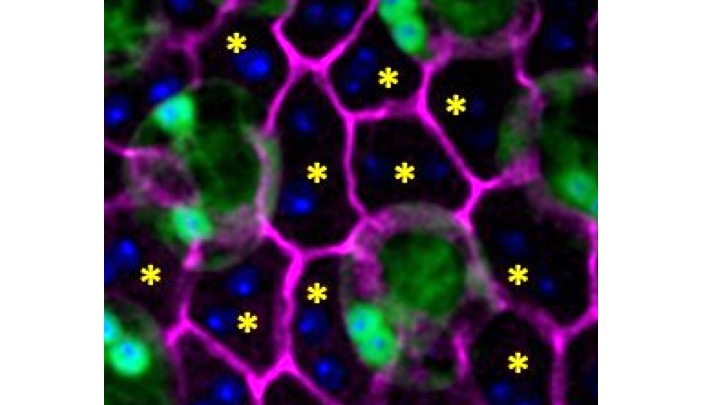
There are two types of secretory cells that form the two lobes of the accessory gland. First, there are the main cells (MCs) that make up 96% of the gland (figure 1A marked by *) and are thought to be responsible for the creation of most of the male seminal fluid proteins, including the most characterized seminal fluid protein, Sex Peptide, responsible for most the post-mating response phenotypes (3) (1). The second cell type in the gland is called the secondary cells (SCs). These larger, rounder cells make up only about 4% of the gland and are located at the distal tip of the gland interspersed by MCs (figure 1A marked by arrowhead). Although most of the seminal fluid proteins seem to be made by the MCs, the SCs have been shown to be required for temporally extending the post-mating response beyond 24 hours (4) (5) (6) (7, 8) (3).
- Wolfner MF. Tokens of love: functions and regulation of Drosophila male accessory gland products. Insect biochemistry and molecular biology. 1997 Mar;27(3):179-92. PubMed PMID: 9090115.
- Wolfner MF, Harada HA, Bertram MJ, Stelick TJ, Kraus KW, Kalb JM, et al. New genes for male accessory gland proteins in Drosophila melanogaster. Insect biochemistry and molecular biology. 1997 Oct;27(10):825-34. PubMed PMID: 9474779.
- Peng J, Chen S, Busser S, Liu H, Honegger T, Kubli E. Gradual release of sperm bound sex-peptide controls female postmating behavior in Drosophila. Current biology : CB. 2005 Feb 8;15(3):207-13. PubMed PMID: 15694303.
- Gligorov D, Sitnik JL, Maeda RK, Wolfner MF, Karch F. A novel function for the Hox gene Abd-B in the male accessory gland regulates the long-term female post-mating response in Drosophila. PLoS genetics. 2013 Mar;9(3):e1003395. PubMed PMID: 23555301. Pubmed Central PMCID: 3610936.
- Sitnik JL, Gligorov D, Maeda RK, Karch F, Wolfner MF. The Female Post-Mating Response Requires Genes Expressed in the Secondary Cells of the Male Accessory Gland in Drosophila melanogaster. Genetics. 2016 Mar;202(3):1029-41. PubMed PMID: 26746709. Pubmed Central PMCID: 4788108.
- Leiblich A, Marsden L, Gandy C, Corrigan L, Jenkins R, Hamdy F, et al. Bone morphogenetic protein- and mating-dependent secretory cell growth and migration in the Drosophila accessory gland. Proceedings of the National Academy of Sciences of the United States of America. 2012 Nov 20;109(47):19292-7. PubMed PMID: 23129615. Pubmed Central PMCID: 3511147.
- Minami R, Wakabayashi M, Sugimori S, Taniguchi K, Kokuryo A, Imano T, et al. The homeodomain protein defective proventriculus is essential for male accessory gland development to enhance fecundity in Drosophila. PloS one. 2012;7(3):e32302. PubMed PMID: 22427829. Pubmed Central PMCID: 3299662.
- Ravi Ram K, Wolfner MF. Seminal influences: Drosophila Acps and the molecular interplay between males and females during reproduction. Integrative and comparative biology. 2007 Sep;47(3):427-45. PubMed PMID: 21672851.